
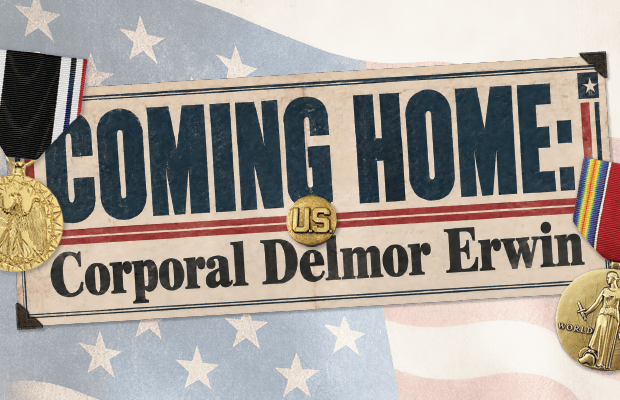
Coming Home
We’ve all heard how DNA technology has made such a difference in recent years—from solving cold cases and uncovering amazing stories through ancestry research to even learning the breed mix of an adopted puppy. But how many of us have ever imagined that DNA technology would make a profound difference in our own families?
That is exactly what has happened for our Erwin family, allowing us to finally share the story of Jim’s uncle, Corporal Delmor Erwin.
Ten years ago, Jim received an unexpected call from a genealogist working on behalf of the United States Army. Her job was to locate the closest living relatives of Jim’s father’s brother, Corporal Delmor Erwin, who had been a Prisoner of War in the Philippines during World War II.
Once she confirmed that Jim was Delmor’s nephew, she asked him to contact the Department of the Army, which was working to bring home missing American soldiers. During that phone call, Jim was asked if he would be willing to provide a DNA sample because he was the closest living male relative to Delmor. DNA samples were also requested from two of Jim’s female first cousins and the daughter of another cousin.
Throughout the process, the teams were careful to say they could not make any promises. But they assured the family that they were continuing to search and would keep working.
Back in the 1940s, Jim’s family had exchanged letters with the U.S. Army, desperately hoping to find a way to bring Delmor home. When the last letter expressed their deep regret and sympathy that it did not appear possible to recover his remains, the family placed a commemorative grave marker where they had hoped to bury him. It was their way of honoring his ultimate sacrifice.
For the next ten years, there was virtually no word about the research.
Then, on March 31, 2026, everything changed.
Jim received the call that his uncle, Corporal Delmor Erwin, had been identified through DNA testing.
At some point during those ten years, Delmor’s remains had been moved from the group grave where he had originally been buried with twelve other soldiers who died that same day and were taken to a research laboratory in Hawaii, where scientists continued the work of identifying America’s missing service members.
Delmor had endured the brutal 65-mile Bataan Death March and then survived months as a Prisoner of War and forced laborer, with very little food, water, or medical attention.
He died of malaria on November 26, 1942, likely from disease-carrying mosquitoes, with his weakened condition made even worse by the many hardships he and the other prisoners had endured.
He was only 20 years old.
Delmor was one of many young men who gave their lives for our country during that time. But to his family, he was so much more than a name on a military record. He was a beloved son and brother, part of a family who never stopped longing to bring him home. One by one, as each of them went to their heavenly home, only one brother remained: Jim’s dad, Charlie Erwin. Charlie never stopped missing his brother. He continued to talk about Delmor throughout his life. Above his desk in the family den, he kept a framed photograph of him—the image capturing what Charlie most wanted to remember: the glistening blue eyes and sweet smile of a young man about to see the world and serve his country in his new military uniform.
In 2008, just days before Christmas, Charlie was living some of his final moments in a hospital bed in Searcy. I sat beside him reading Scripture and stories from a book written by someone describing their own near-death experience and what entering the gates of Heaven had looked like.
I paused at that point. Jim was holding his father’s hand, just as he had held his mother’s hand before her passing on Easter Sunday earlier that same year.
I said, “Charlie, I believe the first person you’ll see when you arrive at Heaven’s gates will be your Dean.” Dean was his beloved wife of more than 60 years. “She is going to look just like she did the day you married her—young and beautiful!”
Then I said, “And Charlie, do you know who I think the second person you are going to see will be? Delmor. He’s been waiting to see you for a long time.”
At that moment, Charlie roused from his coma-like state. He never opened his eyes, but he moved back and forth in his bed several times.
Jim and I could sense that we were witnessing something very special. It was as though, at the mention of Delmor’s name, Charlie was leaving his earthly life. He had waited so long to see his precious youngest brother come home to Arkansas. But the Lord had other plans. God was taking Charlie home to meet Delmor in their heavenly home.
What a blessing it is to know that, after 84 years, Delmor’s earthly body will soon be laid to rest beside his mother and father in a country cemetery in Shirley, Arkansas. He is finally coming home.
We have our military to thank for never giving up on the search. The Lieutenant Colonel coordinating Delmor’s journey home this October told us something we will never forget: The United States of America is the only country in the world that never gives up trying to bring its soldiers home.
They keep searching. They keep trying. Even if it takes 84 years.
This Arkansas soldier is finally coming home. νCarolyn Williams Erwin




0 comments